23 July 2026
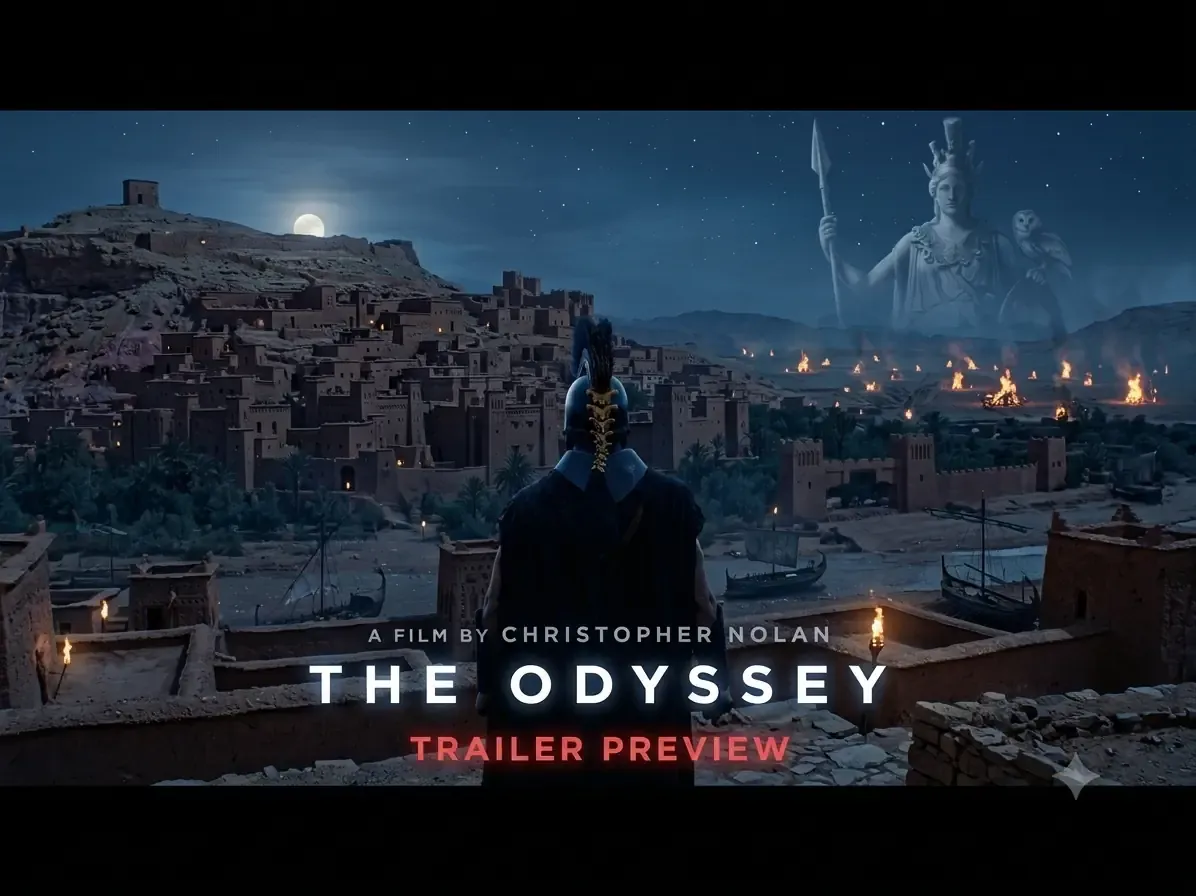
If you have seen Christopher Nolan's The Odyssey, you have already seen Ait Ben Haddou. The fortified clay city that stands in for the doomed citadel of Troy is not a set built on a soundstage — it is a real, living UNESCO village on the edge of the Moroccan desert, and it sits just a few hours from Marrakech. We run trips out to it every week, and since the film landed the questions have not stopped: was this really filmed here, and can I actually go? Yes, and yes. Here is everything you need to know.
Yes — Ait Ben Haddou was the primary Moroccan location for Christopher Nolan's The Odyssey, released in July 2026. The ancient ksar doubled as the legendary city of Troy. Nolan chose the real earthen kasbah over a studio build because its towering mud-brick walls and desert backdrop gave Troy a scale and texture that CGI struggles to match.
It is the latest chapter in a very long film history for this village (more on that below), but it may be the most ambitious. If you want to walk the same lanes Matt Damon's Odysseus did, the easiest way from the city is our Ait Ben Haddou & Ouarzazate day trip.
The production transformed Ait Ben Haddou into Troy on a huge scale. Nolan's team added roughly 60 temporary structures to the existing village — including a pillared Temple of Athena and a set of monumental city gates — spread across about 2.5 acres, then staged Troy's dramatic fall against those walls.
Cinematographer Hoyte van Hoytema lit the destruction with banks of portable LEDs layered over real flames, so the burning-city sequences were captured in-camera around the actual kasbah rather than added later. Standing beneath those same ramparts today, it is easy to see why he wanted the real thing — the light on the clay at dawn and dusk is genuinely cinematic.
Ait Ben Haddou is a fortified village — a ksar — of red-clay kasbahs on the old caravan route between the Sahara and Marrakech. It has been a UNESCO World Heritage Site since 1987, and its earthen towers, some centuries old, are among the finest surviving examples of southern Morocco's pre-Saharan architecture. You will also see it spelled Aït Benhaddou.
The whole village is built from rammed earth and mud brick, rising in tiers up a hillside above the Ounila River. A handful of families still live within the walls, while a small footbridge (and, when the river is low, a set of stepping stones) carries visitors across to the old gate. Climb to the agadir — the communal granary at the very top — for the panoramic view that shows up in so many films.
Ait Ben Haddou is one of the most filmed locations on Earth. Its timeless mud-brick skyline can stand in for ancient Egypt, Jerusalem, Arabia or a fantasy city with almost no set dressing, and nearby Ouarzazate — nicknamed "Ouallywood" — supplies the studios, crews and equipment a big production needs.
Films and series shot in and around the village include:
You can pair the kasbah with the film studios themselves on the Ait Ben Haddou & Ouarzazate day trip, which visits Ouarzazate and its Atlas film studios on the way back.
Essaouira was the film's other big Moroccan location. The windswept Atlantic beaches around the fortified port stood in for the shores where the Trojan Horse is discovered and where Odysseus begins his long voyage home. Morocco's coast and desert together gave Nolan two completely different worlds within a few hours' drive.
Beyond Morocco, the 91-day shoot travelled to Sicily and the Aeolian Islands in Italy, the Peloponnese in Greece, the black-sand beaches of southern Iceland, the coast of Aberdeenshire in Scotland, and water tanks in Malta. If the wild Atlantic scenes caught your eye, Essaouira is an easy coastal escape — see our Essaouira day trip.
Ait Ben Haddou is about a four-hour drive from Marrakech over the High Atlas. The route climbs the spectacular Tizi n'Tichka pass (2,260m) before dropping toward Ouarzazate and the desert. There is no train; the practical options are a guided day trip or a multi-day desert tour that stops on the way.
Because it is a long round trip in a day, most travellers prefer to have the driving handled for them. It also means you can enjoy the mountain scenery instead of navigating the switchbacks yourself.
It depends on how much time you have. A day trip is perfect if the kasbah is your main goal; a multi-day desert tour is better if you also want the Sahara. Both cross the same dramatic mountain pass.
Best for a bucket-list drive. Leave Marrakech in the morning, explore the ksar with a local guide, visit Ouarzazate's film studios, and be back the same evening. See the Ait Ben Haddou & Ouarzazate day trip.
Best for the full southern loop. Ait Ben Haddou is a standard first stop on the desert routes, so you see it on the way to the dunes. Popular choices are the 3-day Sahara tour to Merzouga, the 5-day Grand Tour of the south, and the one-way 4-day Marrakech-to-Fes desert crossing. Short on days? The 2-day Zagora tour also passes through.
Best for photographers and families. Want to arrive for golden hour, take it at your own pace, or build the kasbah into a longer itinerary? Tell us what you have in mind and we will plan it — start with our custom tour planner.
A few things we tell our travellers every week to make the most of the visit:
Ait Ben Haddou was extraordinary long before Nolan's cameras arrived — but there has never been a better moment to see it for yourself. The easiest way from the city is our Ait Ben Haddou & Ouarzazate day trip, or browse all of our day trips from Marrakech. Have a question or a specific date in mind? Get in touch and we will help you plan it.